Imagine flying from Brussels to Tokyo in less than 2 hours and 15 minutes, or from Brussels to Sydney in under 3 hours. This is the concept currently being studied by ESA and its partners.
Concept
High-speed civil transport has always been hindered by limited flight range or excessive fuel consumption, caused by insufficient cruise efficiency.
In recent years, however, radically innovative vehicle concepts have been proposed and developed, with a high potential to reverse this trend. The innovative approach is based on a carefully developed integration of a highly efficient propulsion system with a vehicle concept characterised by a high lift-generating capability.
The trajectories shown below represent the ground tracks of the flights from Brussels to Sydney and from Brussels to Tokyo, respectively.
Flight trajectories table
| Trajectory |
Distance flown [km] |
Great-circle distance [km] |
Total flight time |
Fuel consumption [tonnes] |
| BRU-SYD [1] | 18,734 | 16,734 | 2h47 | 181 |
| BRU-SYD [2] | 18,734 | 16,734 | 2h42 | 171.75 |
| BRU-LAX [3] | 12,845 | 9,075 | 2h20 | 136.8 |
| BRU-NRT | 11,843 | 9,483 | 2h13 | 131.1 |
| BRU-NRT | 11,843 | 9,483 | 2h13 | 119 |
Achieving high propulsive and aerodynamic efficiency relies on minimising the kinetic energy losses of the jet, while striving for the greatest possible uniformity and a minimum induced velocity for lift generation.
The dashed green line in the previous image illustrates the potential of the innovative design methodology.
When analysing the performance of high-speed vehicles designed according to traditional criteria, it can be seen that it decreases almost linearly as the flight Mach number increases, as shown by the red line in the following graph.
The green line, on the other hand, shows the results achieved through revolutionary high-speed civil air transport concepts developed according to the new approach.
Performing a flight test will be the only definitive demonstration of the technical feasibility of the new and promising high-speed flight concepts, in terms of their range and cruise speed potential. Such a result could mark a major breakthrough in high-speed flight and usher in a new era in conceptual vehicle design.
At present, the promised performance can only be demonstrated through numerical simulations or, in part, through experimental tests.
Since high-speed wind tunnels have inherent limitations in terms of size and test duration, it is almost impossible to fully test even relatively simple vehicle configurations in a wind tunnel.
As a result, experiments are limited either to the internal propulsive flow with combustion, but without high-lift surfaces, or to small aerodynamic models, but without a combustion-based propulsion unit.
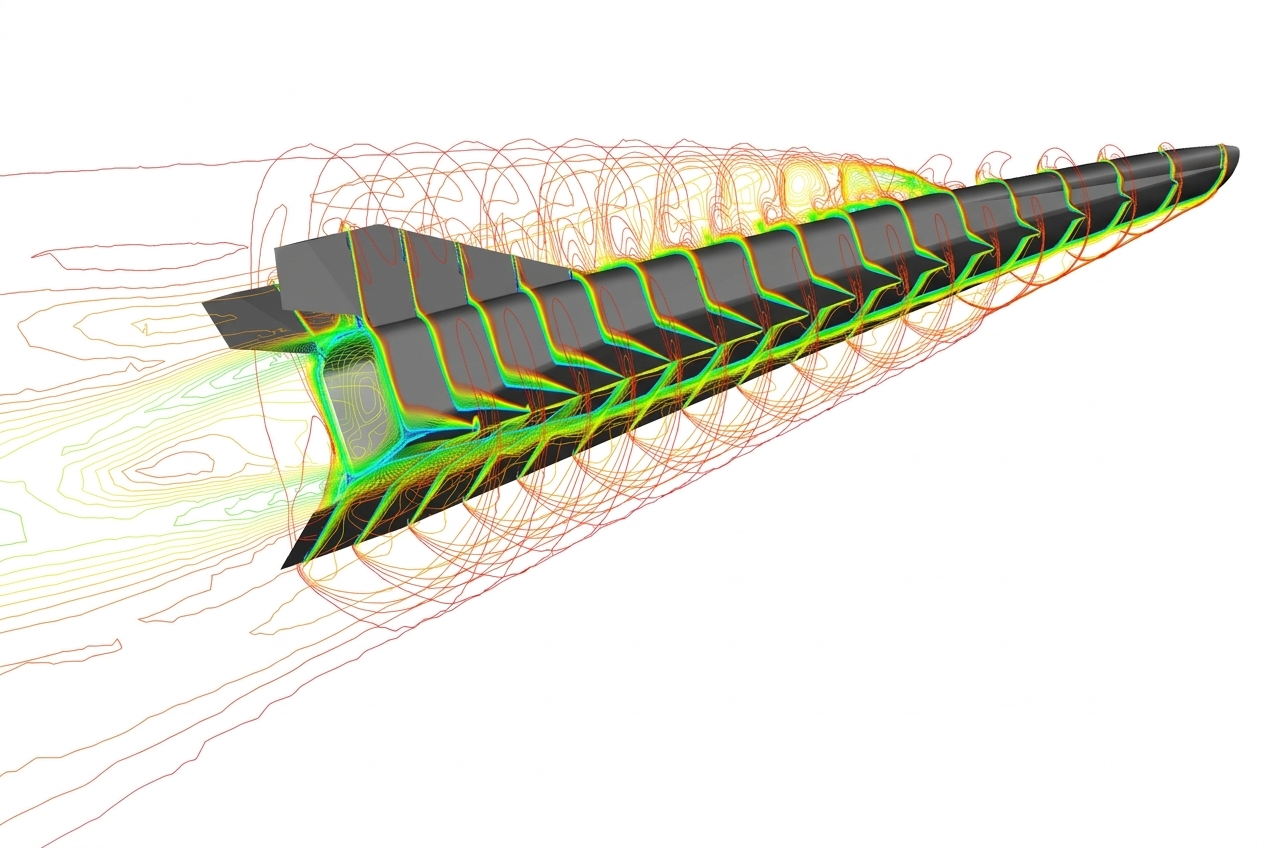
Although numerical simulations are less constrained by geometric dimensions, they involve considerable uncertainties in the modelling of turbulence, chemistry and combustion, making complete predictions of the entire vehicle, from nose to tail (
Nose-to-Tail), unreliable without validation through flight testing.
As a result, the technological developments achieved so far are currently limited to Technology Readiness Level TRL 4, corresponding to component validation in the laboratory.
General objectives
HEXAFLY aims to create a multidisciplinary platform on which various innovative technologies can be integrated to perform high-speed free-flight tests.
This approach will lay the foundations for gradually increasing the Technology Readiness Level (TRL).
The emerging technologies and innovative methodologies, which are strongly dependent on the planned high-speed flight tests, can be grouped into six main areas:
- High-Speed Vehicle Concepts to assess the overall vehicle performance in terms of cruise efficiency, range potential, aero-propulsive balance, aerothermal and structural integration, etc.
- High-Speed Aerodynamics to assess aerodynamic vehicle shapes with a high L/D (lift-to-drag) ratio, aerodynamic manoeuvrability, stability, etc.
- High-Speed Propulsion to assess the performance of high-speed propulsion devices such as intakes, air-breathing engines (ABE) and nozzles (SERN), including phenomena such as high-speed combustion, injection and fuel mixing processes, etc.
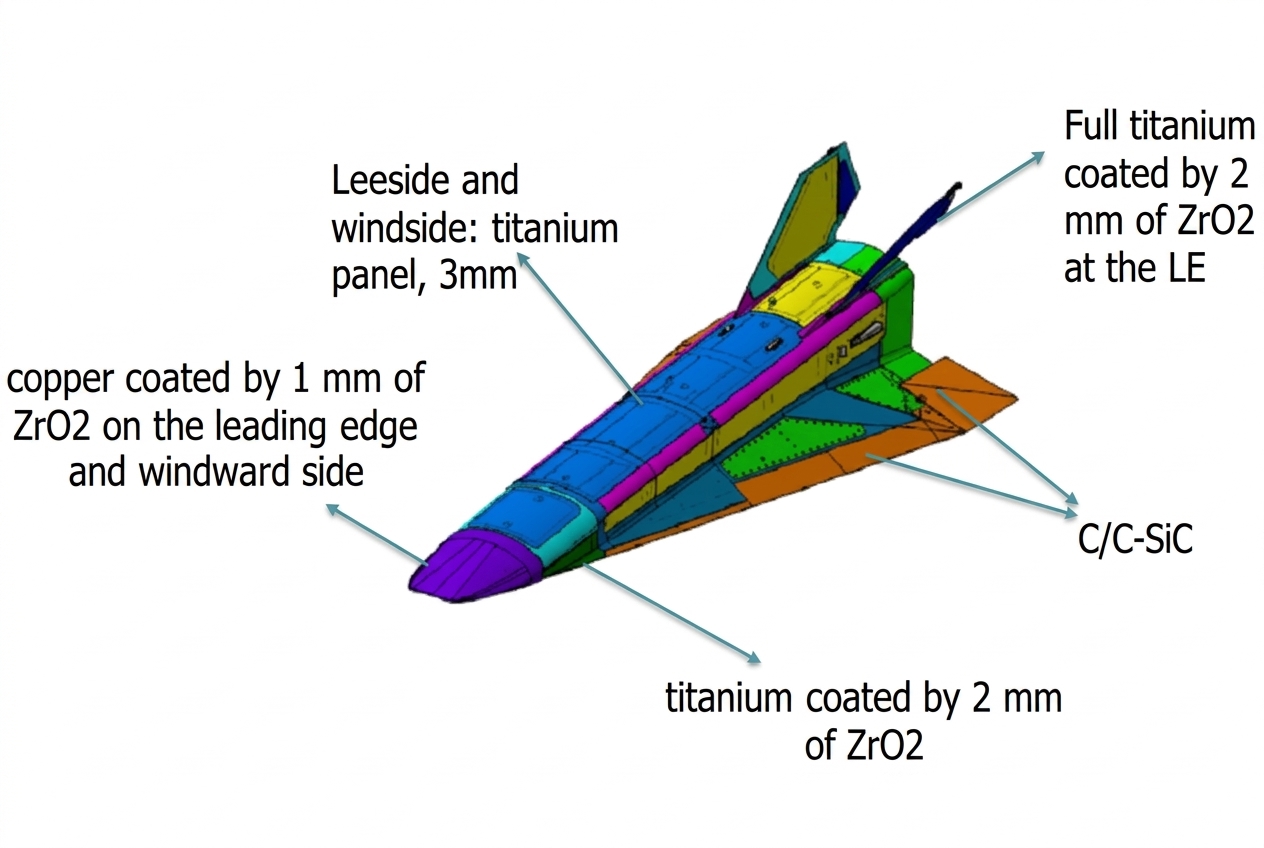
- High-Temperature Materials and Structures to test in flight, under realistic conditions, lightweight high-temperature materials, active and passive cooling solutions, and reusability aspects in terms of oxidation, fatigue, etc.
- High-Speed Flight Control, requiring real-time testing of GNC (Guidance, Navigation and Control) systems in combination with HMS/FDI (Health Monitoring Systems / Fault Detection and Isolation) technologies.
- High-Speed Environmental Impact, with particular focus on sonic boom mitigation techniques and the sensitivity of H₂O, CO₂ and NOx emissions in the stratosphere.
To develop a first flight test campaign, a scientific mission profile was drawn up as part of the preliminary Level 0 project called HEXAFLY, followed by a proof of concept based on:
- A preliminary design of an experimental high-speed flight test vehicle covering the six main areas.
- The selection and integration of technologies already ground-tested and developed within the LAPCAT I and II, ATLLAS I and II and other national programmes.
- The identification of the most promising flight platforms.
These activities made it possible to address the following aspects:
- Identification of the potential technological barriers to be overcome in the subsequent HEXAFLY-INT project.
- Detailed definition of the work plan for carrying out the HEXAFLY-INT project.
- Assessment of progress and of the technological development potential towards a higher TRL.
The design, manufacturing, assembly and verification of the vehicle, combined with a mission profile, will be the main driver and the most important challenge of the HEXAFLY-International project.
The main objectives of the high-speed cruise vehicle, intended to perform a free flight, will be:
- A conceptual design demonstrating high aerodynamic efficiency combined with a large internal volume.
- A controlled gliding flight at a cruise Mach number between 7 and 8.
- The optimal use of advanced high-temperature materials and/or structures.
- An assessment of the sonic boom.
Once the vehicle has been developed, its aerodynamic performance during the transition from Mach 8 to Mach 3–5 may be determined as a secondary objective.
The overall mission requirements are listed in the following table.
Fundamental mission requirements for the EFTV
| Requirement |
Target value |
Minimum value |
Maximum value |
Comment |
| Flight Mach number [-] (Phase I) | 7.4 | 7 | 8 | Phase I: analysis of aerodynamic balance after the pull-out manoeuvre. |
| Flight Mach number [-] (Phase II) | 5 to 7.4 | 3 | 8 | Phase II: the Mach number may gradually decrease during the gliding phase. |
| Flight altitude [km] | 31.9 | 27 | 33 | Optimal condition: level flight. |
| Flight path angle [°] | 0 (level) | 0 | 10 to 15 (TBD) | Accuracy: 0.1 (measured). Accuracy: 5 (TBD) for insertion. |
| Test duration (Phase I with pull-out) [s] | As long as possible | 7 | TBD | Maximum duration entirely defined by the trajectory. |
| Test duration (Phase II) [s] | As long as possible | TBD | Until impact | Duration of the gliding phase defined by the aerodynamic stability range. |
The level of complexity and the number of technologies that can potentially be integrated depend largely on the economically sustainable size of the experimental vehicle.
The ground test facilities currently available in Europe impose a size limit of approximately 1.5 m in length, while a length of approximately 4.5 m appears to be an upper limit for the flight experiments currently under way.
However, the trade-off study carried out within HEXAFLY took the following aspects into account:
- The minimum internal volume required to house all the subsystems needed for a free-flying vehicle.
- A limited budget for hypersonic flight testing.
- The knowledge and expertise recently acquired through the German SHEFEX-I/II projects and the Italian USV project.
- The launch systems currently available at affordable cost.
- The existing databases generated within the ATLLAS I/II and LAPCAT I/II programmes.
- The expertise in high-altitude flight and flight control gained during the SHEFEX II flight and the FAST20XX programme.
- The availability of large test facilities for risk reduction finally led to the identification of an experimental vehicle approximately 3 m long as the most promising solution.
In addition to the high-speed flight experiment, further flight tests will be carried out to verify the feasibility of the vehicle concept with a view to its subsequent use as a passenger aircraft, namely:
- Low-speed flight experiments at the Marulan test site (University of Sydney), to verify the take-off and landing potential of the vehicle based on the waverider configuration.
The project duration was defined so as to allow the international team, made up of Europe, Brazil and Australia, to complete the following main phases:
- Define the requirements and operating conditions of the scientific mission.
- Produce a detailed configuration design of a flight vehicle capable of testing the technologies in the main research areas.
- Define the required flight platform and the related adaptations.
- Perform extensive ground tests and numerical simulations to reduce uncertainties and risks, preferably on representative full-scale models.
- Manufacture the experimental flight test vehicle, together with the necessary adaptations to the launch system.
- Assemble, integrate, verify and test the experimental payload and its launch system.
- Carry out the flight experiment and collect the data.
- Perform a post-flight analysis.
- Disseminate the results.
In addition to the definition of the vehicle and the platform, the suitability of the launch site and test area was assessed in terms of potential constraints on the mission and scientific objectives, namely flight corridors, TTC (Telemetry, Tracking and Command), safety (flight termination) and recovery.
So far, the Alcântara Space Centre in Brazil has been selected as the launch site.